 Depending on the season, there are around 700 rivers and tributaries in the country of Bangladesh, and a majority of them are polluted. Some rivers are so polluted the are almost biologically dead, which means that they are no longer able to support life. There are obvious problems with this, but one of those is that as of December 2025, in Bangladesh only 15% of its more than 176 million people have access to piped water. The rest use the waterways for all water-related things. Furthermore, agriculture is focused on rice paddy and fish farming, so the need for clean wate touches every person.
Dhaka is the capital of the country, where around 21 million people live. The general public is not educated about proper disposal of things like plastic cups, water bottles, and tires, so many people don’t see the issue in using the rivers as trash cans. Worse, “the sewage network …covers only 20 per cent of the population, meaning unimaginable amounts of untreated municipal wastewater is discharged straight into Dhaka’s water bodies. In addition, toxic liquid waste, and even infectious biomedical waste from hospitals, laboratories and other healthcare facilities, are often just poured straight into drains and sewage systems, from where they flow into the rivers untreated. Also, Bangladesh is one of the most prolific producers of fast fashion which has helped move the country from overwhelming poverty to near middle class status. As we know, afast fashion garment dying and production utilize massive amounts of chemicals that are often disposed of by dumping them in waterways - like the ones in Bangladesh. Why is this allowed to happen?
There are anti-pollution laws on the books in the country, but the former government was rife with corruption that allowed bribery so that many laws were not followed. One example is a law requiring all textile factories to have effluent treatment plants that would clean wastewater so clean water could be released back in to waterways. Companies would bribe officials so they did not have to invest in these expensive machines. Other companies that bothered to buy the machines would only use them if inspections were expected, or to make a brief show of how environmentally concerned they were.
Bangladesh has seen political upheaval in recent years, though. In June of 2024, a finding by the country’s Supreme Court created an uprising that grew immensely, and soon protestors were calling for the overthrow of the government. At the end of the uprising, Sheikh Hasina, who had ruled the corrupt government for 15 years, fled with her family to India. Upon her departure, an interim government was put in place, led by a winner of the Nobel Peace Prize, Muhammad Yunus an economist. His government is trying to move the country forward by enacting initiatives to reduce water pollution while also putting an end to the corruption.
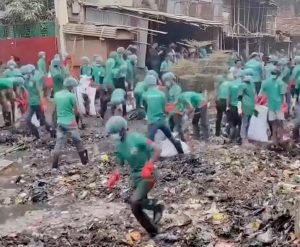
These actions have begun, slowly, to make a difference in waterways in Bangladesh. On top of governmental actions, groups are being formed that work to clean plastic and other solids from the water. That comes with danger, though. The water is so toxic that cuts and scrapes need to be cleaned and treated immediately. Lots of young people are willing to take a chance, though, and they jump right in.
While these actions are making a big difference, they can’t do anything to clean the water that is already toxic. But IX Water can. With large scale systems built to handle immense amounts of water, IX Water’s revolutionary technology could take the water in the rivers and remove pollutants like lead, chromium, arsenic, and PFAS among many others. Toxic water could be made clean enough for rice beds to use (and if you know anything about rice, you know that it often contains high levels of arsenic).
If you think that Bangladesh should be able to have clean water and you would like to help them achieve that, go to startengine.com/Ix-Water and become part of the clean water revolution.
Sources:
https://www.nytimes.com/2025/12/19/opinion/tehran-iran-water-drought-crisis.html?smid=nytcore-ios-share
https://www.worldometers.info/world-population/bangladesh-population/
https://truthout.org/video/nobel-peace-laureate-muhammad-yunus-sworn-in-as-bangladeshs-prime-minister/?gad_source=1&gad_campaignid=437238503&gbraid=0AAAAADbftBnti-oTXayCXRnRZcc4w4z78&gclid=Cj0KCQiAxonKBhC1ARIsAIHq_lvVJUE43oqnXGLkvVrCYIKt8WDr7o5gI01K1WCNvkdzHUv70uruh3UaAmXIEALw_wcB

0 Comments